
BEFORE IT HAS A NAME NAME NAME
Discrimination in Armenia:
numbers, stories, and silence
Some forms of discrimination are easy to recognize.
Others may look ordinary.
- A hiring preference.
- A comment in a shop.
- A staircase that some people cannot use.
- A family expectation.
- A joke.
- A silence.
- An answer that never comes.
Do we always recognize discrimination when it happens?
if we do —
what happens next?
A study of discrimination
as people see it,
live it and respond to it
This is the first comprehensive population-based study on discrimination in Armenia. It combines a nationally representative telephone survey of 2,200 adults with qualitative interviews that bring institutional expertise and personal experience into the same picture. Data collection took place in November-December 2025.
The study does not determine whether individual experiences legally constitute discrimination. Instead, it asks how unequal treatment, exclusion and stigmatization are recognized, normalized, experienced, avoided or challenged in everyday life.
Convergent parallel mixed-methods design, combining a nationally representative survey with qualitative interviews
Discrimination is understood primarily as perceived unequal treatment or exclusion, based on respondents’ own experiences, observations, and interpretations.
Persons with disabilities were identified using the Washington Group Short Set, based on functional limitations rather than only formal disability status.
November through December 2025
Computer-Assisted Telephone Interviewing (CATI) survey was conducted among 2,200 adults aged 18+ who had resided in Armenia for at least three consecutive years. Sampling was based on Random Digit Dialing (RDD) of mobile phone numbers.
Four consultative KIIs were conducted before fieldwork, followed by eight additional KIIs with institutional, expert, and practitioner respondents.
Four IDIs were conducted as intersectional case studies, selected through a 2×2 logic combining vulnerability characteristics and prior discrimination experience.
A serious problem — without a common name
When survey respondents were first asked what “discrimination” meant to them, many struggled to describe it clearly.
After the concept was explained, however, 70.4% said discrimination in Armenia was a serious or somewhat serious problem. Yet fewer than half had initially described discrimination in relevant terms, and 23.4% could not provide a clear answer at all. Among answers that were relevant, only 5.0% offered a relatively detailed description.
The words people used were more likely to circle around ideas such as difference, inequality, bias, or unequal treatment than to frame discrimination as a rights violation.
This matters.
And once we begin asking who is affected, another complication appears.
Who is seen and
who is protected?
There is no single public map of discrimination.
Ask people which groups face widespread discrimination, and one picture emerges.
Ask them which groups they have actually seen being discriminated against, and the picture changes.
Ask them whose rights should receive extra legal protection, and it changes again.
For example, 68.0% of respondents considered discrimination against LGBTQ+ people widespread. Yet only 2.1% of responses to the question about additional legal protection identified LGBTQ+ people as a group whose rights should receive extra protection. By contrast, people with physical and mental disabilities received the strongest support for additional protection, 30.4% and 23.6% of responses, respectively.
The study treats these as related but distinct dimensions. Public awareness of discrimination does not automatically translate into support for protection. Judgements about social distance, sympathy, stigma, and who is perceived as “deserving” can intervene between the two.
Meanwhile, when respondents described discrimination they had actually witnessed, the groups most frequently mentioned were people living in poverty, people with physical disabilities, and people with mental disabilities.
This is an important distinction: being visible as a target of discrimination is not the same as being prioritized for protection.
PERCEIVED AS FACING DISCRIMINATION
SEEN BEING DISCRIMINATED AGAINST
PRIORITIZED FOR EXTRA LEGAL PROTECTION
But even the idea of clearly defined “groups” can only take us so far.
People do not experience life one characteristic at a time.
Where inequalities meet
Imagine trying to understand someone’s experience only through one label.
Woman.
Or:
Person with a disability.
Or:
Displaced person.
Or:
Member of a national minority.
Each category tells us something. None tells us everything.
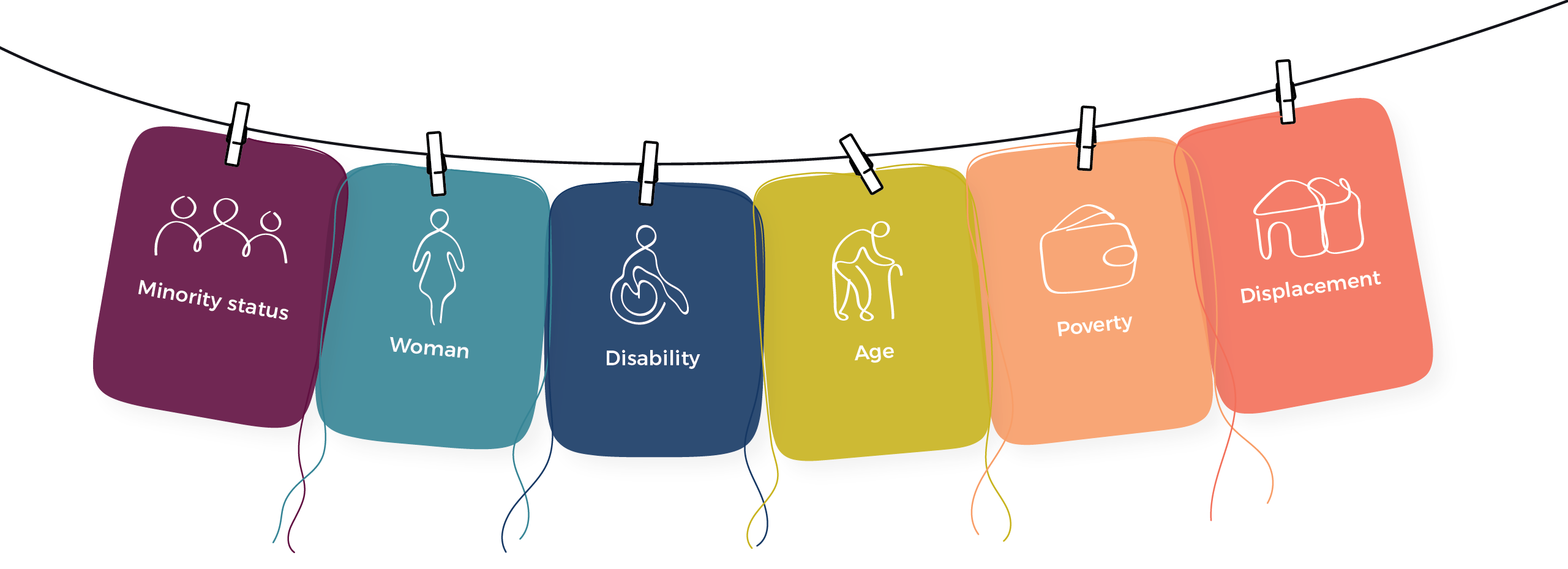
The study’s qualitative evidence repeatedly points to cases where gender, disability, age, poverty, displacement, and minority status interact. The outcome is not always simply “more discrimination.” Sometimes the overlap produces a different kind of vulnerability altogether.
A woman with a disability may experience healthcare differently from both men with disabilities and women without disabilities.
A displaced person living in poverty may face barriers that cannot be explained by displacement or poverty alone.
A Yezidi girl’s situation may be shaped simultaneously by gender, age, community expectations, education, and minority status.
Discrimination is often reproduced not only through individual prejudice but through structural conditions: economic dependence, accessibility barriers, unequal access to services, and institutions designed around an imagined “standard” user.
That distinction is crucial.
A staircase can create vulnerability.
So can inaccessible information.
So can economic dependence.
So can a rule that is formally identical for everyone but much harder for some people to comply with.
The loudest finding is silence
16.5% of the population reported personally experiencing discrimination at least once during the previous five years.
However, among those who personally experienced discrimination, 92.3% did not report their most recent incident anywhere.
Only 1.7% contacted relevant authorities.
Why?
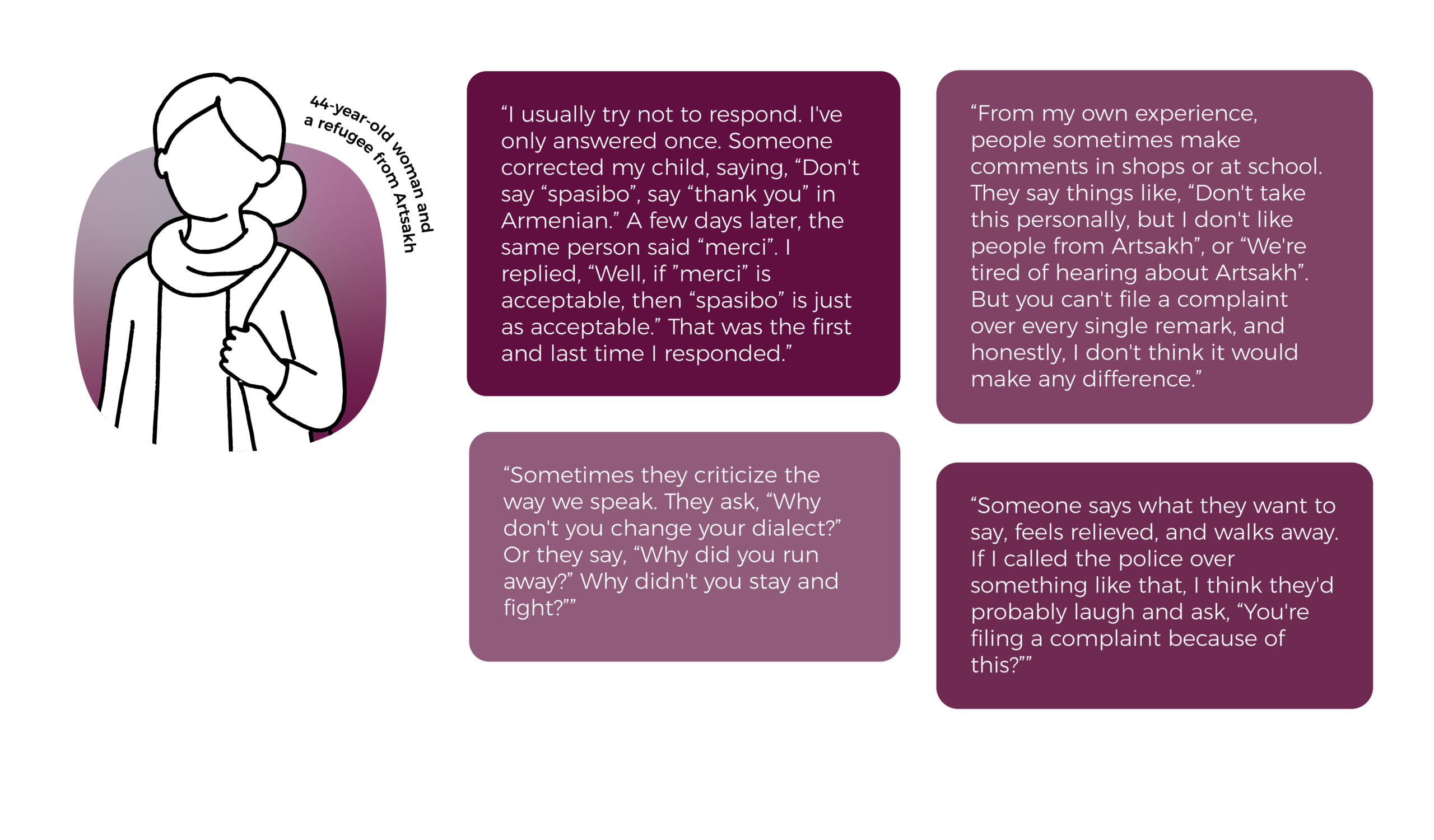
“You know, that’s not such a serious issue, anyway, for me to report it or contact the Human Rights Defender. There was no threat to my person; the person simply expressed his opinion, even if in an offensive way. But if it is serious – of course, if my children are in danger, if my family is in danger – then of course I will contact [the police].”
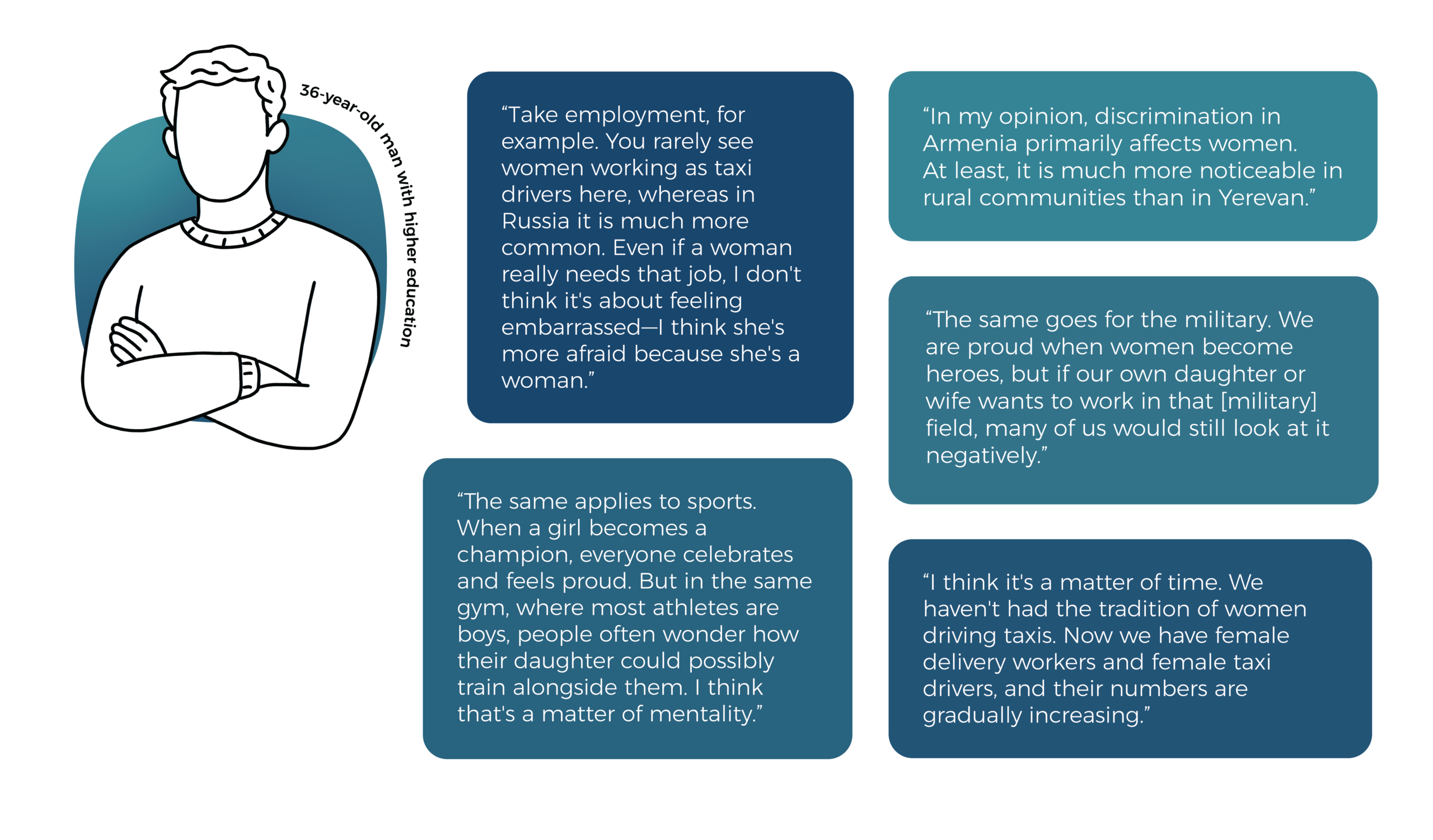
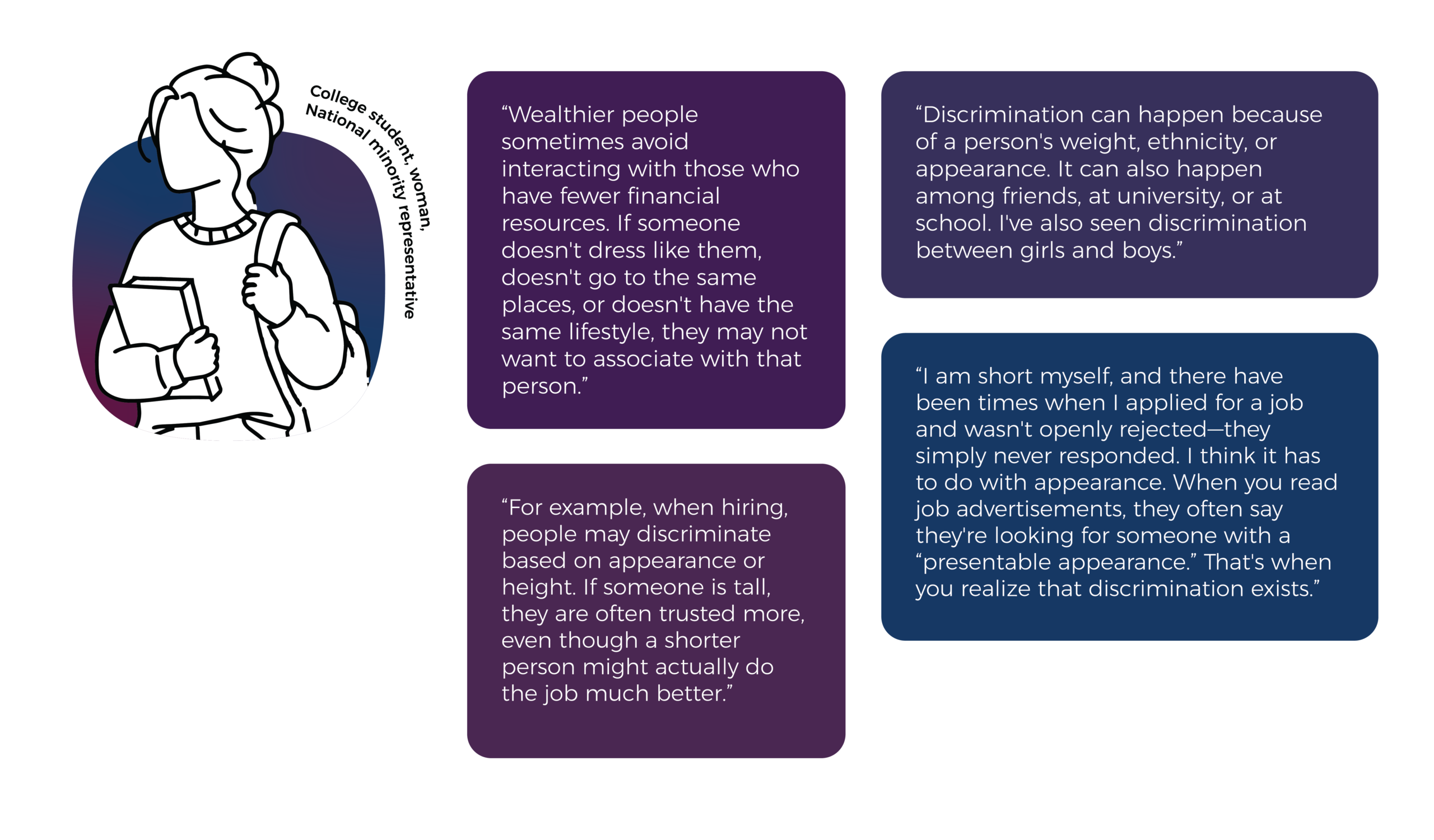
IDI Interviewee, Woman, 44, Refugee from Nagorno-Karabakh
Evidence is only the beginning
What would make equality real in everyday life?
We posit six strategic action pillars.
NAME IT
MAKE REPORTING POSSIBLE
PREPARE INSTITUTIONS
BUILD PUBLIC PERCEPTION
REMOVE STRUCTURAL BARRIERS
MEASURE CHANGE
This publication was prepared by the Caucasus Research Resource Center (CRRC)-Armenia Foundation, commissioned by the Danish Institute for Human Rights in cooperation with the Human Rights Defender’s Office of the Republic of Armenia. The publication was produced with the financial support of the Ministry of Foreign Affairs of Denmark. The CRRC-Armenia Foundation bears sole responsibility for the content of this publication. The findings, interpretations, and conclusions expressed herein do not necessarily reflect the views of the funder or any affiliated institutions.